It's been said that the passion of the human soul finds its food in music. This painting celebrates the spirit and music of the world famous Jenkins Orphanage Band.
This native Charleston band was born from a simple act of charity. In the late 1880's, after discovering four young abandoned boys in an empty railroad car on a frigid morning, Daniel Jenkins, an African American laborer, took the boys home.
Although he and his wife Lena had children of their own and very little money, he believed that the meeting was no random event. He felt he had been chosen for a higher purpose: to be a missionary to the thousands of unwanted black children who had been left out of Charleston's system of public care, thus becoming the founder of The Jenkins Orphanage.
Taken from: "The Cradle of Jazz" by James Hutchisson, Charleston Magazine, April 2005
""Carolina Cotton Fields"", painted on a grand scale, is meant to show a long overdue indebtedness to the African Americans who toiled in our southern landscapes well into the 2oth century, picking cotton by hand before machinery relieved them of their arduous labor.
The painting depicts three black field laborers beginning their day at sunrise. The central dominating figure stands up right and stead fast as she looks to the morning sky with noble determination, as if to say, ""A New Day Is Coming.""
This large oil painted by John C. Doyle was his second in a series devoted to the cotton industry. The original oil painting, which is in Private Collection, measures 60" high and 48" wide.
"I saw children like this in my youth while hunting with my father in the Carolina lowcountry. Children, who through necessity, were forced to grow up fast.
The girl walks in a mans shoes wearing a pair of heavy boots. Yet under her masculine jacket, the hem of a delicately flowered skirt reveals her femininity. The Bloodhound, a breed favored by royalty, symbolically connects the girl to her own noble soul.
The 16-gauge shotgun held by the girl is more than a means to feed her family. It embodies a code of ethics and responsibility handed down through generations.
~ The Artist, John Doyle
"Market Street vendors, such as we see here, provided downtown Charleston with meat, poultry, and vegetables before the arrival of modern super markets.
This painting depicts the concerns of small businesses as the mother reassures her daughter that all will be provided while they await the first sale of the day."
~ The Artist, John Doyle
"In the late 1940's Charleston was the home port to a collection of merchant marines, dock workers, and watermen of all descriptions.
Many had little formal schooling but possessed an "education" that came from travel to distant ports-of-call like Cuba, Puerto Rico, and Panama.
These characters, like the one pictured here filled with swagger and tattoos, told stories of tramp steamers working between Charleston and Jacksonville, as well as the torrid zones of dark rum and dark-eyed women."
~ The Artist, John Doyle
"Many times, Charleston has been rated the most polite city in America. Having been raised a Charlestonian, I grew up in an atmosphere of manners based on respect for others. This tradition of gentility, often associated with the Southern blue-bloods, was actually taught at all levels of Charleston Society.
In Picnic on the Sandbar, we see an African-American couple of humble means who have rowed from Charlestons peninsula to a sandbar just south-west of Fort Sumter. The gentleman in the painting, raised, as myself, to show chivalrous respect to women, bows and assists his lady from her carriage and onto the sand. A blanket and picnic basket await the couple, preludes to a romantic lunch, with Charlestons harbor at their feet."
~ The Artist, John Doyle
"Many times, Charleston has been rated the most polite city in America. Having been raised a Charlestonian, I grew up in an atmosphere of manners based on respect for others. This tradition of gentility, often associated with the Southern blue-bloods was actually taught at all levels of Charleston Society.
In Picnic on the Sandbar, we see an African-American couple of humble means who have rowed from Charlestons peninsula to a sandbar just south-west of Fort Sumter. The gentleman in the painting, raised, as myself, to show chivalrous respect to women, bows and assists his lady from her carriage and onto the sand. A blanket and picnic basket await the couple, preludes to a romantic lunch, with Charlestons harbor at their feet."
~ The Artist, John Doyle
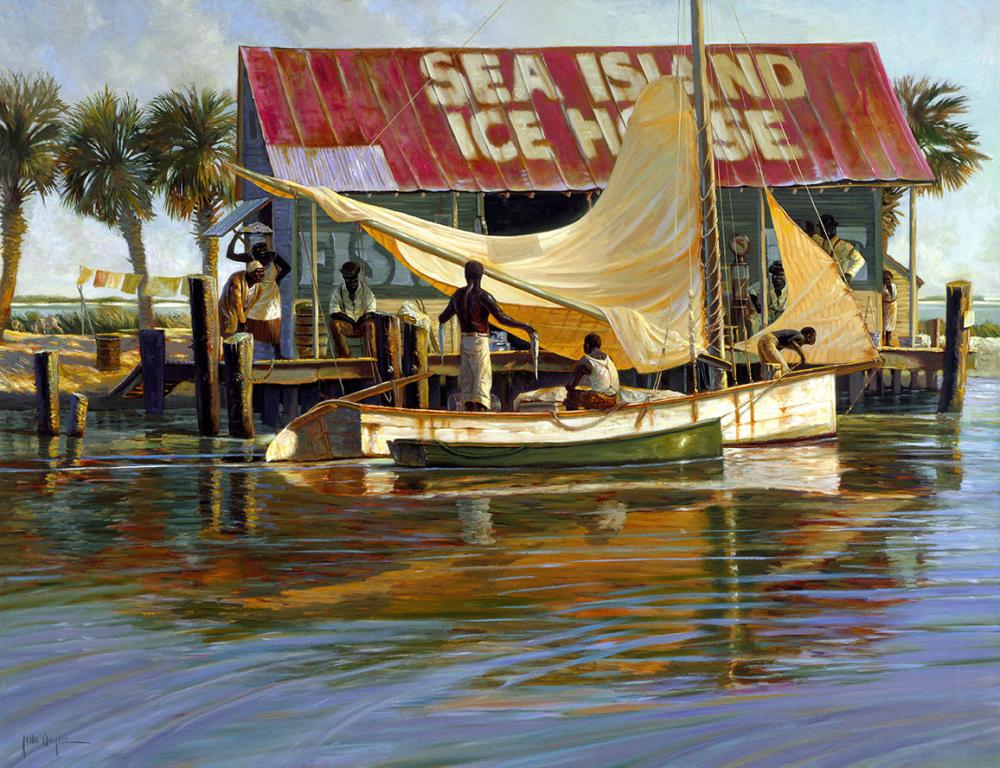
"From the sea islands in the Carolinas to the harbors of the Caribbean, not very long ago "Mosquito Fleets" of black fisherman harvested the salt water bounty to eat and to sell to the residents of coastal towns. These were somewhat "general stores" along the water-ways, and these ice houses and bate sheds served these small fleets with ice, gossip, and credit." The Artist, John Doyle
"Anyone who plays the guitar will immediately see that this little girl is left-handed and is forced to play the instrument upside down. The girl is a universal symbol of the handicaps we all have. We are all "different" in some ways.
Some of us come from the backgrounds of abuse. Some of us were born poor and are forever struggling to rid ourselves of impoverished self-esteem covered up by false confidence.
To treat these "handicaps" we must learn the art of love. In the painting the white goat embodies this love and stands by the little girl's side.
Like all true love the goat does not care if she is black, a female, poor or left-handed. The goat only knows that the music coming from the girl is very real and, to it's ears, very sweet.
If we did not receive this unconditional love as a child we must teach it to ourselves................we must be self-taught."
~ The Artist, John Doyle
"In most cultures, there is a mythology that addresses our
journey into an afterlife. Often, these stories include a
guide whose job it is to deliver us to our final reward.
In 'The Coachman,' I have painted a black carriage driver
who is employed in doing this work...
He smiles a Cheshire cat grin, as if to say, Hey, cousin, its you, not me, that's responsible for your fate.
In one hand he holds a bull whip, for those who have
conveniently detached themselves from their conscience, becoming strangers to their souls.
In his other hand, for those of us who have been good, a cream pie awaits, for a joyful party that will last for Eternity."
~ The Artist, John Doyle
"In most cultures, there is a mythology that addresses our
journey into an afterlife. Often, these stories include a
guide, whose job it is to deliver us to our final reward.
In 'The Coachman,' I have painted a black carriage driver
who is employed in doing this work...
He smiles a Cheshire cat grin, as if to say, Hey, cousin, it's you, not me, that's responsible for your fate...
In one hand he holds a bull whip, for those who have
conveniently detached themselves from their conscience, becoming strangers to their souls.
In his other hand, for those of us who have been good, a cream pie awaits, for a joyful party that will last for Eternity."
~ The Artist, John Doyle
"This painting, set in the Depression era of the
1930's, is a celebration of those who
take control of their lives. Here we see a
young self employed business man,
hardworking and diligent, who provides a
much needed service with a smile."
~ The Artist, John Doyle